Training a Rottweiler requires patience, consistency, and clear communication from every family member involved. These intelligent and powerful dogs learn quickly, but they also notice inconsistency faster than many owners expect. Unfortunately, many households unknowingly create confusion through mixed signals, unclear expectations, and poor timing during training sessions. Understanding common Rottweiler command mistakes can help families build calmer behavior, stronger obedience, and healthier communication with their dog over time.
Because Rottweilers naturally thrive on structure, unclear commands often lead to frustration for both the dog and the owner. Many behavior problems blamed on stubbornness actually develop from inconsistent training patterns inside the home.
Correcting Rottweiler command mistakes early helps prevent confusion while creating a more stable learning environment for the dog.
Most importantly, consistent communication strengthens trust and makes daily life far easier for everyone involved.
Using Different Words for the Same Command
One of the most common problems families create involves inconsistent wording during training.
Many Rottweiler command mistakes begin when different people use different phrases for identical behaviors. One family member may say “down,” while another says “lie down” or “get down.” Although humans understand the similarity, dogs often interpret these as separate instructions entirely.
Consistent language helps dogs learn faster because repetition creates stronger associations between the word and the expected action.
Simple, clear commands usually work best for long-term obedience training.
Families should agree on exact words before serious training begins.
Repeating Commands Too Often
Many owners accidentally teach dogs to ignore commands by repeating them constantly.
Among the most damaging Rottweiler command mistakes is saying commands multiple times before expecting compliance. Owners often repeat “sit” five or six times without enforcing the behavior.
Dogs quickly learn that responding immediately is unnecessary because the command will continue repeating anyway.
Instead, owners should give the command once clearly and calmly. Then they should guide the dog toward the expected behavior if necessary.
Consistent follow-through builds faster understanding and better long-term responsiveness.
Inconsistent Household Rules Create Confusion
Rottweilers pay close attention to patterns and routines within the household.
Many Rottweiler command mistakes occur because one family member allows behavior another person discourages completely.
For example, one person may allow jumping on furniture while another punishes it harshly. Consequently, the dog receives conflicting information daily.
Consistent household rules help dogs understand expectations clearly while reducing anxiety and confusion.
Everyone in the home should follow the same boundaries, commands, and behavioral standards whenever possible.
Using Commands During Emotional Moments
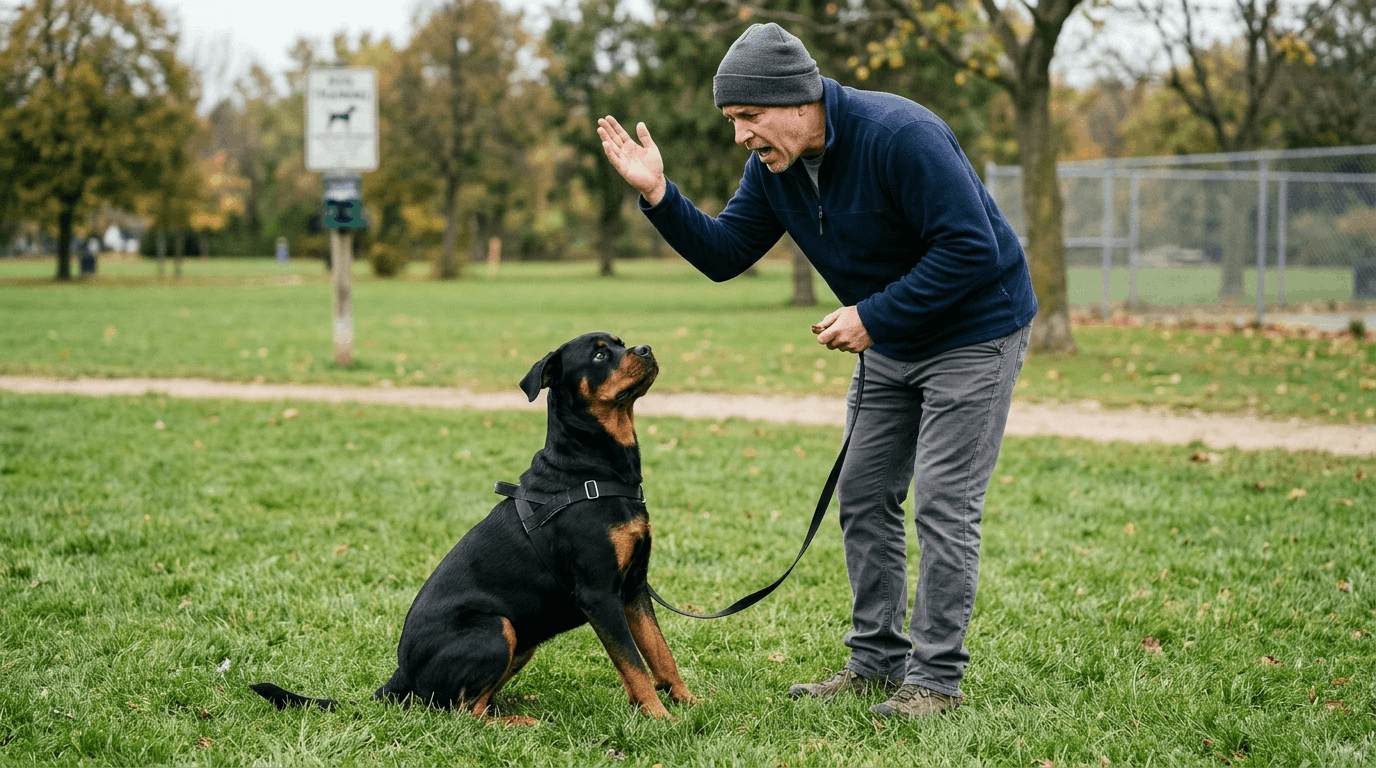
Frustration sometimes causes owners to raise their voices or use commands emotionally.
However, emotional reactions often worsen Rottweiler command mistakes because dogs respond best to calm and confident leadership.
Shouting commands repeatedly may create anxiety rather than understanding.
Additionally, emotional correction often confuses dogs because they focus more on tone than the actual instruction itself.
Calm communication helps maintain trust while encouraging clearer learning during training sessions.
Steady leadership usually produces more reliable results than frustration-driven correction.
Poor Timing Weakens Learning
Timing plays a critical role in effective dog training.
Many Rottweiler command mistakes happen because rewards or corrections occur too late for the dog to connect cause and effect properly.
Dogs learn best when feedback happens immediately after behavior occurs.
For example, rewarding a sit several seconds later may confuse the dog about which action earned praise.
Similarly, delayed corrections rarely help because the dog no longer associates them with the original behavior.
Immediate responses create clearer communication and faster learning overall.
Rewarding Unwanted Behavior Accidentally
Families often reinforce bad habits unintentionally without recognizing the problem immediately.
Some Rottweiler command mistakes involve giving attention during whining, barking, jumping, or demanding behavior.
Even negative attention sometimes rewards dogs because interaction itself becomes reinforcing.
For example, pushing away a jumping dog may still encourage excitement and attention-seeking behavior.
Instead, calm behavior should consistently earn rewards, praise, or engagement.
Clear reward timing helps dogs understand exactly which behaviors receive positive responses.
Training Sessions That Last Too Long
Rottweilers are intelligent dogs, but mental fatigue still affects concentration significantly.
Many Rottweiler command mistakes happen when owners continue training far beyond the dog’s attention span.
Long repetitive sessions may create boredom, frustration, or reduced responsiveness.
Short focused sessions generally work far better than lengthy exhausting drills.
Most dogs respond best to several brief training periods spread throughout the day.
Ending sessions positively often improves future motivation and engagement as well.
Giving Commands Without Follow-Through
Commands lose meaning quickly when owners fail to reinforce expectations consistently.
Among the most serious Rottweiler command mistakes is allowing dogs to ignore instructions repeatedly without consequence.
For example, calling a dog repeatedly while allowing refusal teaches selective listening over time.
Owners should avoid giving commands they cannot enforce realistically.
Reliable obedience develops when dogs understand that commands consistently lead to expected outcomes.
Consistency matters far more than harshness during effective training.
Confusing Corrections With Punishment
Many families misunderstand the difference between correction and punishment entirely.
Harsh reactions sometimes increase fear, anxiety, or defensive behavior instead of improving obedience.
Some Rottweiler command mistakes involve overly aggressive discipline methods that damage trust and communication.
Calm redirection usually works better than emotional punishment.
Rottweilers thrive under confident leadership emphasizing structure, consistency, and clarity rather than intimidation.
Positive reinforcement combined with fair boundaries often produces stronger long-term results.
Ignoring Mental Stimulation Needs
Behavior problems sometimes stem from boredom rather than disobedience.
Many Rottweiler command mistakes develop because owners focus only on physical exercise while neglecting mental engagement.
Intelligent dogs need problem-solving activities, obedience challenges, and interactive learning regularly.
Without mental stimulation, some dogs create their own entertainment through destructive or attention-seeking behaviors.
Training games, scent activities, puzzle feeders, and advanced obedience exercises help maintain better focus and emotional balance.
Using Too Many Commands at Once
Dogs process information more clearly when instructions remain simple and direct.
Some Rottweiler command mistakes occur because owners overload dogs with lengthy verbal explanations.
For example, saying “come here right now because you know better” creates unnecessary noise around the core instruction.
Short direct commands improve clarity and faster understanding significantly.
Simple communication also helps maintain calmer energy during training interactions.
Failing to Practice in Different Environments
Dogs may obey perfectly at home but struggle completely in distracting situations.
Many Rottweiler command mistakes happen because training only occurs inside quiet familiar environments.
Reliable obedience requires gradual exposure to parks, sidewalks, visitors, noises, and public distractions.
Generalizing commands across multiple locations strengthens long-term responsiveness substantially.
Dogs must learn that commands apply everywhere, not just inside the house.
Accidentally Encouraging Pulling During Walks
Leash manners create ongoing frustration in many households.
Some Rottweiler command mistakes begin early when pulling accidentally moves the dog closer toward exciting destinations.
Dogs quickly learn that tension on the leash sometimes works effectively.
Consistent leash handling helps prevent these habits from becoming deeply ingrained.
Rewarding calm walking and stopping movement during pulling often creates better walking behavior over time.
Expecting Immediate Perfection
Many owners become discouraged when progress takes longer than expected.
However, realistic expectations matter greatly during dog training.
Some Rottweiler command mistakes happen because families expect adult-level obedience from puppies or newly adopted dogs immediately.
Learning requires repetition, patience, and gradual improvement.
Small consistent improvements usually matter more than demanding instant perfection.
Celebrating progress helps maintain positive motivation for both the owner and the dog.
Inconsistent Body Language Sends Mixed Signals
Dogs observe body language constantly during training interactions.
Many Rottweiler command mistakes involve conflicting physical cues that contradict spoken commands.
For example, owners sometimes step backward while calling dogs forward or appear tense during obedience work.
Calm confident posture supports clearer communication and stronger leadership.
Dogs often respond more strongly to body language than spoken words alone.
Allowing Excitement to Override Structure
Excitement sometimes causes owners to abandon consistency unintentionally.
Guests entering the home often trigger several common Rottweiler command mistakes because rules suddenly disappear during stimulating moments.
Dogs quickly notice when expectations change depending on circumstances.
Maintaining structure during exciting situations helps improve impulse control significantly.
Calm greetings, controlled introductions, and consistent routines often reduce overexcitement naturally.
Comparing Dogs Unfairly
Every Rottweiler develops at a slightly different pace depending on genetics, experience, confidence, and training history.
Some owners create unnecessary frustration by comparing their dog constantly to others.
These comparison-driven Rottweiler command mistakes often lead to unrealistic expectations or inconsistent handling.
Instead, owners should focus on steady improvement and individual progress.
Building confidence and communication takes time, especially with intelligent working breeds.
Strong Communication Builds Better Behavior
Successful training depends far more on consistency than perfection. Most behavior problems improve dramatically when families communicate clearly and follow the same structure daily.
Avoiding common Rottweiler command mistakes helps dogs understand expectations while reducing frustration and confusion throughout the home.
Simple commands, calm leadership, clear timing, and consistent routines usually create the strongest foundation for long-term obedience.
Most importantly, training should strengthen trust rather than create tension. Rottweilers respond exceptionally well to confident owners who provide structure, patience, fairness, and positive reinforcement consistently. When families work together with clear communication and realistic expectations, these intelligent dogs often become calm, loyal, and highly responsive companions for many years.
FAQ
1. Why do Rottweilers ignore commands sometimes?
Inconsistent communication, unclear expectations, or repeated commands often weaken responsiveness.
2. How many commands should a dog learn at once?
Dogs usually learn better when owners focus on one or two commands at a time.
3. Should every family member use the same training words?
Yes, consistent wording helps dogs understand commands faster and reduces confusion significantly.
4. Are long training sessions effective for large breeds?
Short focused sessions usually produce better concentration and stronger learning outcomes.
5. What is the biggest training mistake owners make?
Inconsistency remains one of the most common causes of poor obedience and behavioral confusion.